
A daily sales tracker for Philippine food carts
Know exactly what each cart sold today. CGRAM logs in-store sales per product, delivery-platform totals, and eWallet receipts — then rolls them into a daily revenue figure you can trust.
Crew enter sales in a guided flow on their phone; you see the numbers the moment they sync.
No card needed · Works offline · Made for Philippine food businesses
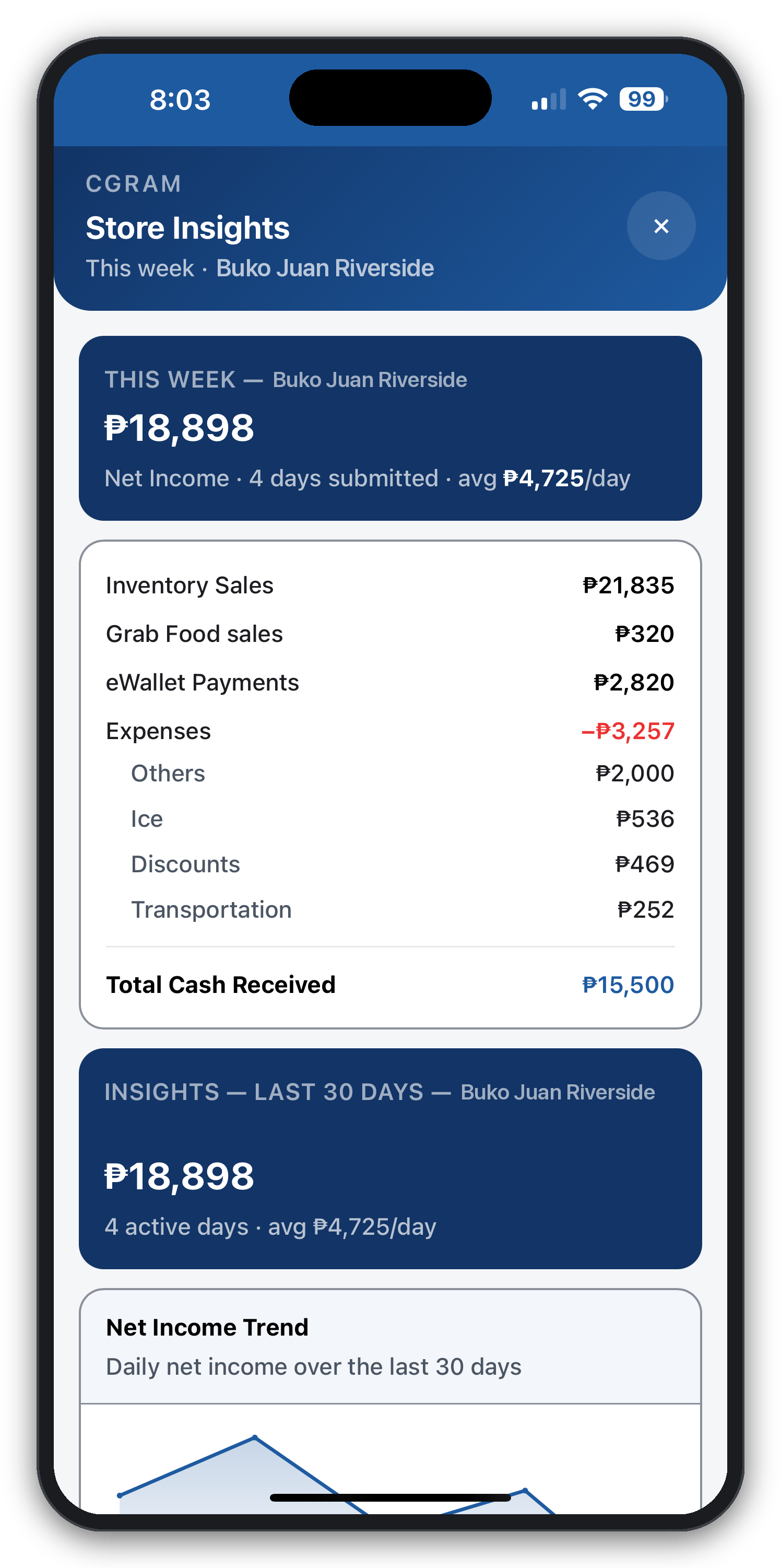
Per-product in-store sales
Crew enter quantities sold for each product. CGRAM computes revenue against your configured prices — no mental math, no missed items.
Delivery & eWallet totals
Capture FoodPanda and GrabFood daily totals plus GCash and Maya receipts in one step, so digital sales never get lost.
GCash deposit & fee tracking
Log each GCash deposit and its fee. CGRAM accumulates monthly fees so you can see what cash-handling actually costs.
Daily revenue per cart
Every store reports its own daily sales. Owners see all carts side by side and spot a slow day before the week is over.
Crew leaderboard & platform ROI
Rank crew by sales and see which delivery platform actually earns its commission — turn raw numbers into decisions.
Logs sales offline
A busy lunch rush in a signal dead-zone still gets recorded. Entries sync automatically once the cart is back online.
Sales tracking that fits a one-screen workflow
CGRAM's crew flow is a forward-only wizard — one screen at a time, no skipping. When it's time to record sales, crew enter quantities per product and the app does the peso math against your prices. Digital sales from FoodPanda, GrabFood, GCash, and Maya are captured in the next step.
Because everything is entered on the spot and synced incrementally, you're never reconstructing a day from memory at closing time.
See cash and digital revenue in one place
A food cart's money arrives in three streams: cash in the drawer, delivery-platform payouts, and eWallet receipts. CGRAM ties all three to the same day and the same store, then subtracts expenses and GCash deposits to show the cash that should be in the drawer at close.
That cash-accountability chain — beginning cash plus sales minus expenses minus deposits — carries forward to the next day, so a shortfall surfaces immediately instead of at month-end.
Built for Philippine SME food businesses
From a single jeepney-side cart to a multi-store franchise, CGRAM serves the full range of Philippine food operators. Delivery-platform entry is manual by design (no fragile API integration to break), and eWallet handling matches how GCash and Maya are actually used at the cart.
Start free for 30 days, then pay from ₱99/month. Pricing is framed per day — roughly ₱10/day per store on the Starter plan — because that's how a kiosk owner thinks about cost.
Questions, answered
Can I track sales from FoodPanda and GrabFood?
Yes. CGRAM captures the daily total from each delivery platform as a manual entry, alongside in-store and eWallet sales, so your full revenue picture lives in one place.
Does it track GCash deposits and fees?
Yes. Each GCash deposit is logged with its fee, and CGRAM accumulates the monthly fee total so you can see your cash-handling cost over time.
Can I compare sales across carts?
Yes. Each store reports its own daily sales and the owner dashboard shows every cart together. The crew leaderboard ranks staff by sales performance.
Will it record sales if the cart has no signal?
Yes. Sales entries are saved on the device and sync automatically when the connection returns — a dead spot never costs you a day's data.
Explore more
Run your kiosk from your phone — starting today
Try CGRAM free for 30 days. No card needed. Or message us for a live 15-minute demo on Messenger.
- Works offline
- Set up in minutes
- Cancel anytime